Digital transformation in wealth management involves modernising and connecting the technology, data and workflows that support client relationships, investment operations and regulatory requirements. For many wealth management firms, the challenge is not simply adopting new software but addressing fragmented systems, inconsistent client information, manual processes and legacy platforms that limit operational efficiency.
A successful wealth management technology transformation connects CRM, digital onboarding, portfolio management and reporting systems while improving the digital client experience. Achieving these improvements requires more than introducing new tools; firms must also establish reliable integrations, maintain data quality and incorporate security and governance into their technology decisions. This article explores the key technology priorities, implementation challenges and practical steps wealth managers should consider when developing a digital transformation roadmap.
What Does Digital Transformation Mean in Wealth Management?
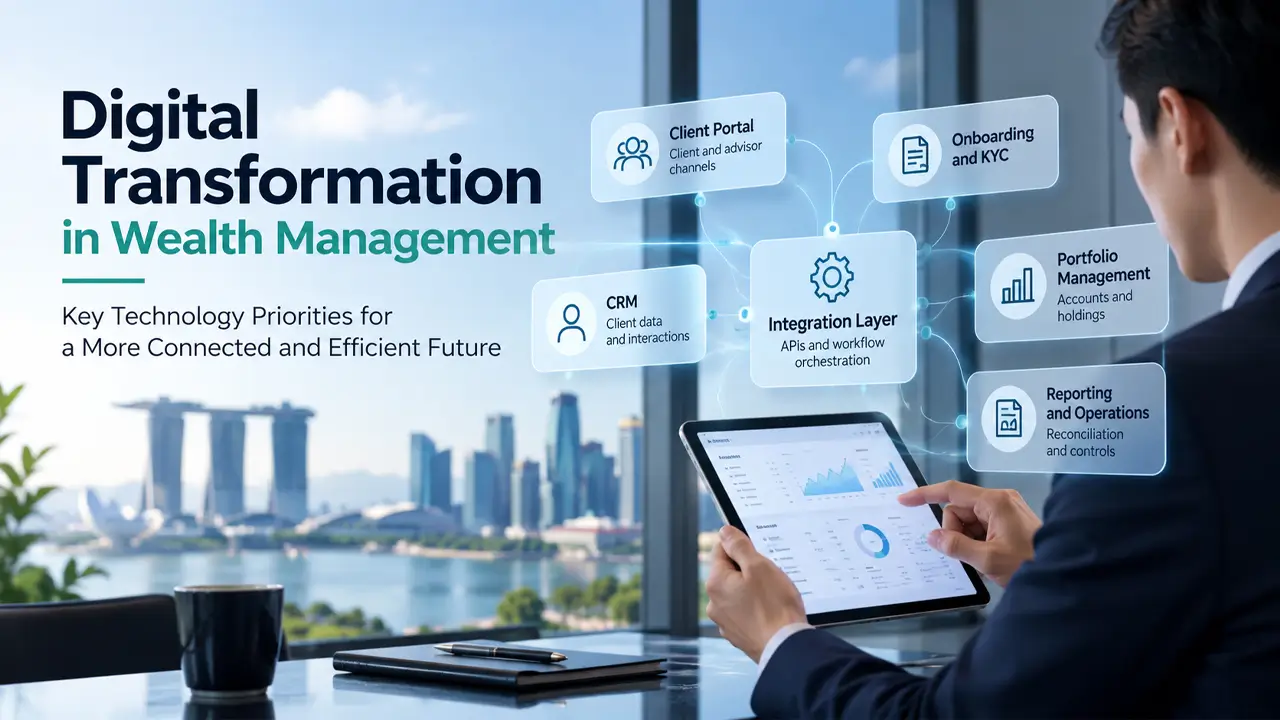
Digital transformation in wealth management involves modernising and connecting the technology, data and business processes that support client relationships, investment operations and regulatory activities. Rather than simply introducing new software, it focuses on improving how information flows across the organisation. For example, a client portal delivers greater value when it connects with CRM, onboarding and portfolio systems, allowing authorised users to access consistent information without relying on manual updates across multiple applications.
The Difference Between Digitisation and Digital Transformation
Digitisation converts existing information or processes into digital formats, while digital transformation involves redesigning workflows and connecting systems to achieve broader operational improvements. Replacing paper onboarding forms with electronic documents is digitisation; integrating those forms with identity verification, compliance checks, CRM and account-opening workflows represents a more comprehensive transformation. This distinction helps wealth managers move beyond isolated technology upgrades towards connected processes that reduce manual work and improve service delivery.
Why Connected Systems Matter in Wealth Management?
Wealth managers depend on multiple systems to manage client relationships, accounts, portfolios, transactions and reporting. When these applications operate independently, employees may need to reconcile information manually, switch between platforms or maintain duplicate records. A connected technology environment establishes clear data ownership and reliable information flows between authorised systems. By integrating existing platforms, standardising data and improving workflows, firms can enhance operational efficiency and information consistency without necessarily replacing every legacy system.
Why Wealth Management Technology Transformation is Challenging
Wealth management firms often operate complex technology environments shaped by legacy investments, acquisitions, regulatory requirements and changing client expectations. Applications supporting different business functions may not be designed to work together, creating integration challenges and limiting operational efficiency. Understanding these constraints helps firms identify modernisation priorities before investing in new platforms or launching a transformation programme.
Key challenges include:
- Fragmented Systems and Duplicate Data: Client information is often spread across CRM platforms, onboarding tools, portfolio management systems and reporting applications. Separate records and disconnected update processes can lead to duplicate data entry, inconsistent client profiles and difficulties identifying reliable information.
- Legacy Platforms and Difficult Integrations: Older wealth management systems may continue to support essential operations but lack modern interfaces or flexible integration capabilities. Custom connections, outdated data formats and undocumented dependencies can increase maintenance costs and make modernisation more complex.
- Manual Processes Across Onboarding and Client Servicing: Disconnected applications and handoffs between teams can require employees to re-enter information, chase missing documents and coordinate approvals manually. These activities increase processing time and make operational bottlenecks harder to identify.
- Regulatory, Security and Data-Governance Constraints: Wealth management firms handle sensitive financial and personal information and must account for access permissions, data retention, audit trails, third-party dependencies, business continuity and applicable regulatory obligations. New integrations and cloud services can introduce additional considerations for how information is stored, processed and accessed.
Key Technology Priorities for Digital Transformation in Wealth Management
Digital transformation in wealth management requires firms to prioritise technology investments that address operational challenges and improve how systems work together. Rather than upgrading applications independently, wealth managers should focus on connecting CRM, onboarding, portfolio management and reporting systems to create a more integrated technology environment. The following priorities highlight where modernisation can improve operational efficiency, data accessibility and client servicing.
Integrating Core Wealth Management Systems
Wealth management firms often rely on separate applications for CRM, client onboarding, account administration, portfolio management and reporting. When these systems cannot exchange information reliably, employees must transfer data manually, reconcile records and repeat tasks across platforms. APIs and integration platforms can connect these applications, enabling controlled data exchange and reducing unnecessary manual work.
A connected wealth management environment relies on an integration layer that enables core applications to exchange information securely and consistently. The following architecture illustrates how client-facing channels, CRM, onboarding, portfolio management and reporting systems can work together, supported by shared data governance and security controls.
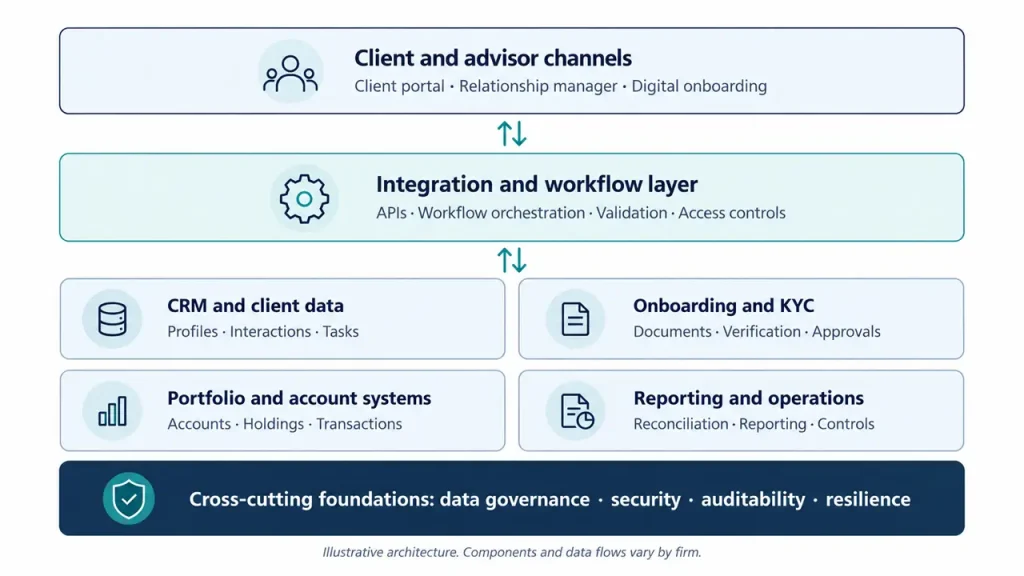
Successful integration requires firms to establish several key foundations:
- Data ownership: Identify which system is authoritative for each type of information.
- Data mapping: Align fields, identifiers and business definitions across applications.
- Validation rules: Identify missing, inconsistent or invalid information before it reaches downstream systems.
- Error handling: Define how to manage failed updates, unavailable systems and rejected transactions.
- Access controls: Restrict data access and modifications to authorised users and applications.
- Monitoring and reconciliation: Detect failed exchanges, discrepancies and unresolved exceptions.
For example, when a client’s contact details change in the designated source system, a controlled integration can distribute the update to relevant applications. Validation and monitoring help maintain consistent records while protecting data integrity.
Modernising Wealth Management CRM
CRM transformation helps relationship managers manage client profiles, interaction histories, meeting notes, follow-up tasks and servicing activities more effectively. However, its value is limited when employees must switch between applications to retrieve account information or maintain duplicate records. Connecting CRM with onboarding, document management and account systems can provide authorised employees with a more complete view of client relationships.
Key priorities include:
- Establishing consistent client records and reducing unnecessary duplication.
- Connecting CRM with relevant onboarding, document management and account systems.
- Providing relationship managers with appropriate client and interaction information.
- Automating routine reminders, follow-ups and internal task assignments.
- Standardising workflows while accommodating different client-service requirements.
- Improving visibility into relationship activity, outstanding tasks and operational bottlenecks.
Before implementing a new platform, firms should define business requirements, clarify data ownership and assess integration dependencies. This ensures CRM modernisation addresses actual relationship-management challenges rather than simply replacing an existing application.
Improving Digital Client Experience in Wealth Management
Digital client experience depends on how easily clients can access relevant information, complete service requests and communicate with their wealth management provider. Avaloq’s 2026 Wealth Insights research found that 46% of surveyed wealth professionals identified insufficient digital client-servicing tools as a barrier to focusing on clients. This highlights the importance of providing accessible digital services, supported by reliable system integration and accurate information, while ensuring that digital channels complement personal advice and relationship management.
Important priorities include:
- Consistent client information: Present appropriate, up-to-date information from relevant source systems.
- Convenient self-service: Enable clients to access documents and complete supported activities digitally.
- Connected service workflows: Route client requests to the appropriate team and track their progress.
- Consistent communication: Coordinate digital communications with relationship-manager follow-ups.
- Accessible design: Make digital services clear and usable for clients with different needs.
- Appropriate security: Apply suitable authentication, authorisation and privacy controls.
Wealth managers should map key client journeys to identify whether friction originates from the interface, an inefficient process, poor data quality or disconnected systems. Digital services should complement personal advice and relationship management while making routine interactions more convenient.
Digitising Client Onboarding and KYC Workflows
Client onboarding involves collecting information, verifying identities, completing compliance checks, obtaining approvals and setting up accounts. When these activities span disconnected applications, employees may repeatedly request documents, track progress manually and re-enter information. Digital onboarding can coordinate the process through structured workflows that connect verification, approvals and account creation.
A typical digital onboarding workflow includes:
- Information collection: Capture client details and required documents through an appropriate digital channel.
- Validation: Check that information is complete and identify inconsistencies.
- Identity and compliance checks: Connect to approved verification and screening processes.
- Review and approval: Route applications to the relevant employees or compliance teams.
- Account setup: Transfer approved information to account or portfolio administration systems.
- Confirmation and recordkeeping: Record outcomes and retain required evidence.
- Exception handling: Escalate incomplete applications or cases requiring additional assessment.
Integrating onboarding with CRM and account administration is essential to reducing repeated data entry. Firms should also ensure that automation preserves required compliance checks and provides appropriate human review for exceptions.
Connecting Portfolio Management and Reporting Platforms
Portfolio management and reporting systems process information about accounts, holdings, transactions, valuations and investment performance. When these platforms are disconnected from CRM, account administration or client-facing channels, firms may experience reporting delays, inconsistent records and additional reconciliation work. Effective integration establishes which system is authoritative for each data element and how information moves between applications.
Key considerations include:
- Aligning client and account identifiers across applications.
- Establishing controlled data flows for holdings, transactions and valuations.
- Defining the frequency and timing of data updates.
- Reconciling discrepancies between source systems and downstream reports.
- Maintaining controls over data adjustments and corrections.
- Identifying data sources, timestamps and relevant limitations where appropriate.
For example, a reporting platform may receive holdings and valuation information from a portfolio system, while CRM accesses selected account information to support client servicing. Defining update schedules, validation rules and reconciliation procedures helps maintain reporting consistency. Integration improves data accessibility, but reliable reporting still depends on data quality and clear accountability.
Modernising Legacy Platforms and Architecture
Legacy platforms may continue to support critical wealth management operations while limiting integration, flexibility and future development. The UK’s Financial Conduct Authority reported in its 2026 wealth management survey that 13% of surveyed firms used in-house or third-party AI tools, rising to 45% when firms considering adoption within the following 12 months were included. As firms explore new capabilities, they need to assess whether their existing architecture can support integration, data access, security and controlled implementation. Replacing legacy systems entirely can introduce migration risks and operational disruption, so firms should determine whether incremental improvements, modular replacement or broader platform transformation is most appropriate.
Incremental modernisation improves selected components, interfaces or workflows while retaining the underlying platform. Modular replacement introduces specific capabilities that connect with existing systems, whereas broader platform transformation replaces or substantially redesigns a larger part of the technology environment when current platforms cannot meet essential business requirements.
The decision should consider technical conditions, vendor support, business criticality, integration capabilities, security and long-term costs. Cloud adoption may also support modernisation, but firms must assess regulatory requirements, data residency, resilience and third-party dependencies before moving workloads. A phased implementation approach helps manage migration risks and maintain business continuity.
Strengthening Data Governance, Security and Operational Resilience
Data governance, security and operational resilience underpin every wealth management technology initiative. Firms need clear data ownership, consistent definitions and visibility into how information moves between systems. Access controls protect sensitive information, while audit trails support accountability and help establish how important activities and changes occurred.
Transformation programmes should address several core requirements:
- Data ownership and lineage: Document the origin, meaning and movement of important data.
- Identity and access management: Restrict system access according to roles and responsibilities.
- Auditability: Maintain appropriate records of activities, approvals and changes.
- Third-party dependencies: Assess risks associated with vendors, integrations and externally hosted services.
- Testing and recovery: Validate recovery arrangements and continuity plans for critical services.
- Regulatory alignment: Incorporate applicable legal, regulatory and internal control requirements into system design and implementation.
These controls should extend across integrations, reporting applications and client-facing platforms. Embedding governance and resilience into the architecture from the outset helps wealth managers modernise operations while maintaining appropriate oversight.
How to Build a Wealth Management Digital Transformation Roadmap
A digital transformation roadmap translates business objectives into prioritised technology and process improvements. It should account for dependencies between systems, data, employees and regulatory controls while enabling firms to modernise operations without disrupting critical services.
A phased approach helps wealth managers manage implementation risks, deliver measurable improvements and establish a foundation for future modernisation.
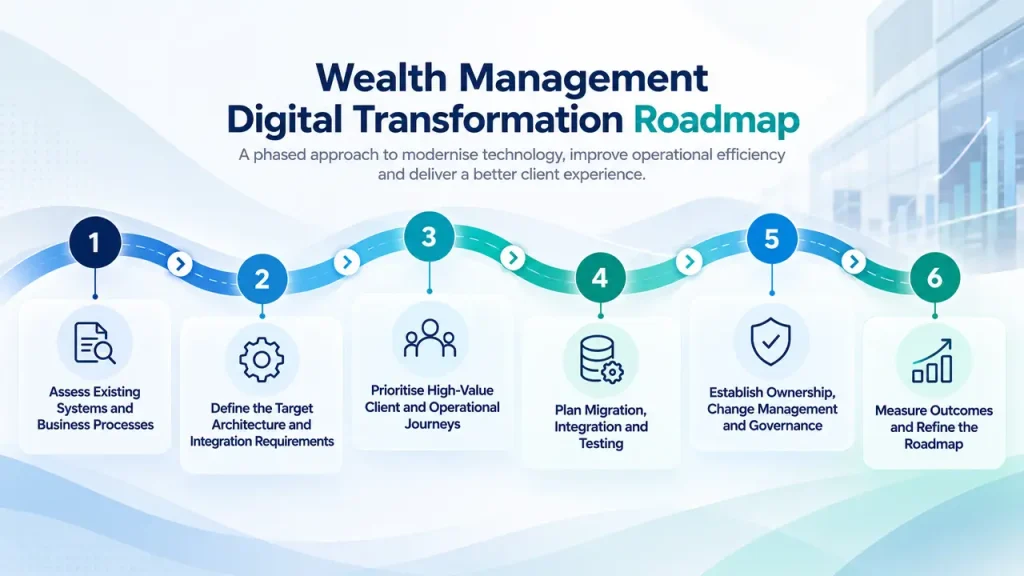
Step 1: Assess Existing Systems and Business Processes
Begin by mapping the current technology environment, including core applications, data sources, system interfaces, manual workarounds and operational dependencies. Review the client and operational lifecycle, from onboarding and relationship management to portfolio administration, reporting and ongoing servicing.
Consult business users and operations teams to identify duplicated data entry, processing delays and inefficient workflows. The outcome should be a documented assessment of existing systems, operational pain points, risks and opportunities for improvement.
Step 2: Define the Target Architecture and Integration Requirements
Use the assessment to define how the future technology environment should operate. Identify the systems responsible for core business functions, establish authoritative data sources and determine how applications will exchange information. Specify integration patterns, data standards, security controls and monitoring requirements.
The target architecture should address business needs while accounting for vendor limitations, existing contracts, migration complexity and the need to maintain critical operations. This ensures technology decisions support the broader transformation strategy rather than introduce unnecessary complexity.
Step 3: Prioritise High-Value Client and Operational Journeys
Rather than modernising every system simultaneously, prioritise workflows that offer meaningful business benefits and have manageable implementation requirements. Potential initiatives include reducing repeated data entry during onboarding, improving CRM access to client information, connecting portfolio data to reporting platforms and automating selected internal approvals.
Evaluate each initiative based on expected business impact, implementation effort, technical dependencies, risk and organisational readiness. This provides a practical basis for sequencing investments and allocating resources.
Step 4: Plan Migration, Integration and Testing
Before implementation, establish how data and workflows will move from existing systems to the target environment. Migration planning should cover data mapping, cleansing, validation, reconciliation, cutover arrangements and the treatment of incomplete or inconsistent records.
Integration and user acceptance testing should verify that information flows correctly, business rules are applied consistently, access controls work as intended and failures can be detected and resolved. Relationship managers, onboarding teams and operations staff should validate the redesigned workflows, while critical systems should have appropriate fallback, recovery and business-continuity arrangements before deployment.
Step 5: Establish Ownership, Change Management and Governance
Successful transformation requires clear accountability for business requirements, architecture decisions, data quality, delivery milestones, risk management and operational readiness. Programme governance should also provide visibility into project dependencies, key decisions, risks and delivery progress, ensuring individual initiatives remain aligned with the wider transformation strategy.
Prepare employees for changes to their roles and workflows through targeted communication, training and feedback channels. Input from affected teams can help identify adoption challenges and refine processes after implementation.
Step 6: Measure Outcomes and Refine the Roadmap
Treat digital transformation as an ongoing improvement programme rather than a one-time technology deployment. Compare results against the baseline established during the initial assessment, using measures such as onboarding completion times, manual processing requirements, data discrepancies, workflow delays and the availability of accurate client information.
Use these findings to address remaining gaps, reassess priorities and guide subsequent phases of modernisation. Regular reviews help firms direct investment towards improvements that deliver measurable operational and client-service value.
How to Measure the Success of Digital Transformation
Digital transformation outcomes should be evaluated through a combination of operational, client-service, technology and adoption measures. The most useful indicators are those that reflect the business problems the programme was designed to address.
| Measurement area | Example indicators | What they help assess |
| Onboarding efficiency | Median onboarding time, time awaiting approval, incomplete application rate | Whether onboarding workflows are becoming more efficient |
| Operational productivity | Manual processing time, repeated data entry, exception volumes | Whether employees spend less time on avoidable administrative work |
| CRM adoption | Active usage, workflow completion, record completeness | Whether the CRM supports actual relationship-management activities |
| Data quality | Duplicate records, reconciliation discrepancies, unresolved data errors | Whether information is becoming more consistent and reliable |
| Client experience | Service-request turnaround, digital task completion, client feedback | Whether clients can complete activities more conveniently |
| Technology reliability | Integration failures, service availability, recovery performance | Whether the connected environment operates reliably |
| Delivery performance | Milestone completion, defect rates, unresolved dependencies | Whether implementation is progressing in a controlled manner |
Firms should evaluate outcomes alongside potential trade-offs, as faster workflows are not successful if they increase errors or weaken controls. Effective measurement should balance operational efficiency, service quality, data integrity, risk management and sustainable adoption to ensure technology investments deliver meaningful business improvements.
Conclusion: Building a Connected Wealth Management Technology Environment
Digital transformation in wealth management requires more than adopting new technology. It depends on connecting core systems, improving data consistency and redesigning workflows to support efficient operations and better client experiences. Modernising CRM, digitising onboarding and integrating portfolio and reporting platforms can help firms address fragmented processes while maintaining appropriate security, governance and operational resilience.
A structured transformation roadmap enables wealth managers to prioritise investments, manage implementation risks and measure business outcomes. By aligning technology, data, processes and people, firms can build a more connected environment that adapts to changing business and client needs.
Finalix supports financial services organisations with technology transformation, platform implementation, integration and programme delivery. By translating business priorities into coordinated execution, firms can move beyond isolated technology upgrades towards a more integrated and sustainable approach to modernisation.