
Regulatory transformation in banking involves more than updating policies or meeting reporting deadlines. As regulatory expectations evolve, banks must translate requirements into practical changes across business processes, technology platforms, data governance, internal controls and operating models. The challenge is not simply understanding what a regulation requires. It is implementing those requirements consistently across the organisation while maintaining operational stability and demonstrating that controls work as intended.
This requires coordinated efforts across compliance, legal, risk, finance, operations, data and technology teams. Fragmented systems, inconsistent data and unclear ownership make regulatory change difficult to manage. These challenges are greater for banks operating across multiple jurisdictions. However, automation, improved data architecture and regulatory technology offer opportunities to improve compliance. These solutions can help banks build more efficient and adaptable processes. Understanding how regulatory transformation works is essential. Banks also need to identify implementation challenges and measure outcomes. This helps them establish a sustainable approach to regulatory change.
What is Regulatory Transformation in Banking?
Regulatory transformation in banking is the process of turning regulatory obligations into practical changes across a bank. These changes may involve processes, technology, data, controls, governance and the operating model. It connects regulatory interpretation with business implementation. Each affected team must understand its responsibilities. Banks must also ensure that changes are implemented, tested and maintained effectively.
Unlike routine compliance monitoring, which focuses on identifying and managing compliance risks, regulatory transformation involves broader organisational changes. These changes help banks meet regulatory expectations. Banking regulatory change management is a key part of this process. It involves identifying, assessing, implementing and monitoring regulatory developments. For example, new supervisory reporting requirements may affect several areas. These include data fields, source systems, calculation logic, validation rules and approval workflows. Treating these activities as one coordinated transformation programme helps banks manage dependencies and reduce the risk of inconsistent implementation.
Why Regulatory Transformation Matters for Banks?
Banks operate within regulatory environments that influence capital management, risk controls, customer onboarding, financial crime prevention, data handling, reporting and technology resilience. When requirements change, the impact can extend across multiple business functions, applications and jurisdictions. A structured regulatory compliance transformation approach helps banks respond to these changes while maintaining operational stability and establishing clearer accountability.
Managing Complex Regulatory Requirements
Regulatory developments may originate from different authorities, apply to different business activities and have different implementation timelines. Banks operating across multiple jurisdictions must identify which requirements apply to the entire group and which affect specific legal entities or markets. A structured assessment process helps banks identify applicable obligations and translate them into business requirements. This reduces the risk of overlooking important changes. It also clarifies accountability across the organisation.
Improving Operational Efficiency
When regulatory activities rely heavily on spreadsheets, manual reconciliations and disconnected approval workflows, teams may spend considerable time gathering information and checking the same data repeatedly. Process redesign and appropriate automation can reduce repetitive work, improve consistency and create clearer audit trails. However, automation is most effective when the underlying processes, data definitions and control requirements are already well understood.
Strengthening Data Quality and Reporting Reliability
Regulatory reporting depends on accurate, complete and traceable data. When information is spread across disconnected systems or uses inconsistent definitions, producing reliable reports can be difficult. It may also require extensive manual work. Regulatory transformation helps banks improve data ownership and standardise definitions. It also supports better data lineage and stronger validation controls. These improvements make it easier to investigate discrepancies and explain reported figures.
Supporting Technology Modernisation
Legacy banking platforms may not readily accommodate new reporting fields, control requirements or integration needs. Repeatedly adding isolated fixes can increase technical complexity and make future changes more difficult. A coordinated transformation programme allows banks to evaluate whether existing systems can be enhanced, whether new capabilities are needed and how changes should fit into the wider technology architecture.
Improving Accountability and Governance
Regulatory obligations often cross departmental boundaries. Compliance teams may identify a requirement, operations may own the affected process, and technology teams may be responsible for implementing system changes. An effective governance model connects regulatory interpretation, business decisions, technology delivery and control validation, establishing who approves requirements, who owns implementation, who accepts residual risks and who confirms that changes operate effectively.
How Regulatory Transformation Changes Banking Operations

Regulatory transformation affects how banks design workflows, manage information, operate technology and assign responsibilities. Its impact extends beyond compliance departments because regulatory obligations frequently influence the systems and processes used by other business functions.
Business Process Redesign
Regulatory changes may introduce additional checks, approval requirements, information-gathering activities or monitoring responsibilities. Banks must map these changes to existing workflows and update procedures accordingly. For example, revised customer due diligence requirements may affect onboarding forms, customer risk assessments, document collection and periodic reviews. Process redesign ensures that regulatory obligations become part of daily operations rather than remaining documented only in policies.
Compliance Technology and System Integration
Banking compliance technology includes compliance management platforms, case management systems, transaction monitoring tools and regulatory reporting applications. These solutions must integrate with relevant banking applications and operational workflows. A new compliance platform cannot deliver its full value if teams still rely on disconnected spreadsheets or manually transfer information between systems.
Data Governance and Lineage
Clear data ownership, consistent definitions and documented data lineage help banks trace information from source systems through calculations to its final use in reports. These capabilities make it easier to investigate discrepancies, identify the source of errors and understand how a regulatory change affects downstream systems. They also support more consistent reporting and stronger evidence of control execution.
Regulatory Reporting Transformation
Regulatory reporting transformation focuses on improving the data, processes, controls and technology used to prepare and submit regulatory information. Banks may consolidate data sources, standardise reporting definitions, automate calculations and strengthen validation procedures. The objective is not simply faster report production, but greater accuracy, traceability and control over reported information.
Operating Model and Governance Adjustments
Regulatory change can require responsibilities to be redistributed between compliance, risk, operations, finance and technology teams. A bank may need to establish new control ownership, clarify escalation routes or introduce a central function to coordinate regulatory change across business units. The target operating model should define how obligations are identified, who interprets them, who assesses their impact, who delivers changes and who verifies implementation. Clear responsibilities help prevent duplicated work and gaps between regulatory interpretation and operational execution.
The Regulatory Transformation Implementation Lifecycle
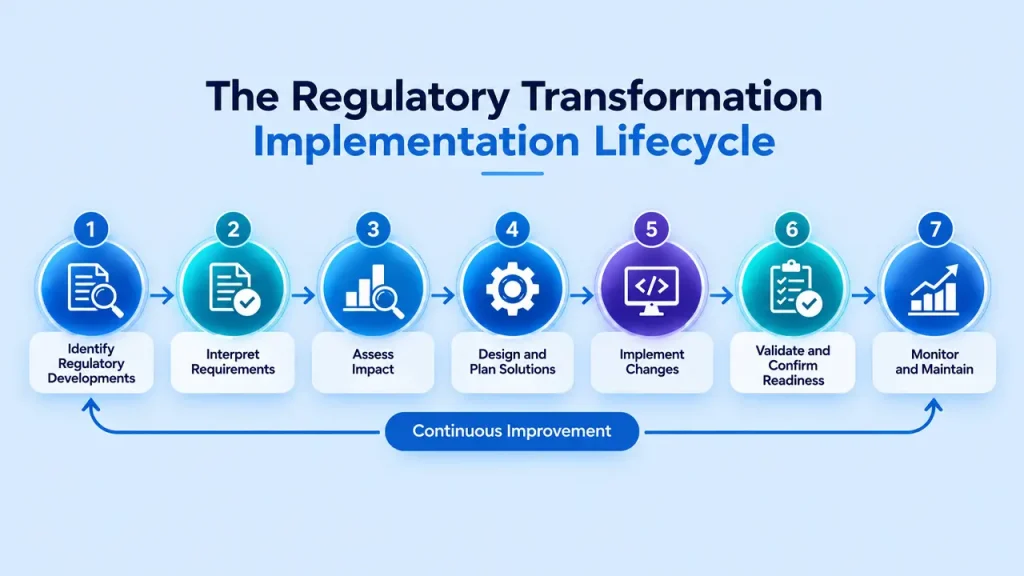
A structured implementation lifecycle helps banks translate regulatory developments into controlled, measurable changes. Although the exact process varies according to the regulation, jurisdiction, institution and risk involved, seven stages provide a practical foundation for banking regulatory change management.
- Identify Applicable Regulatory Developments: Monitor relevant regulatory publications, supervisory communications, legislation and technical standards to determine which requirements apply to the bank’s activities, products and jurisdictions.
- Interpret Requirements and Define Obligations: Translate regulatory texts into actionable requirements, clarify responsibilities and document the evidence needed to demonstrate compliance.
- Assess the Impact Across the Organisation: Identify how new requirements affect business processes, controls, data, applications, reporting, employees and third-party dependencies.
- Design the Target Processes, Controls and Technology: Define the necessary process changes, system modifications, data requirements, control measures and governance responsibilities.
- Implement and Coordinate Delivery: Execute approved changes through coordinated workstreams covering technology, data remediation, workflows, policies and staff training.
- Validate the Implementation and Confirm Readiness: Test system functionality, data accuracy, reporting outputs and control effectiveness, retaining evidence of results, approvals and resolved issues.
- Monitor Ongoing Compliance and Maintain the Solution: Track subsequent regulatory developments, update affected systems and controls, and conduct post-implementation reviews to identify weaknesses and improvement opportunities.
Following these stages helps banks establish clear accountability, manage implementation dependencies and maintain evidence that regulatory obligations have been addressed. The lifecycle should be treated as an ongoing process, allowing banks to adapt their controls, systems and procedures as regulatory expectations evolve.
Key Challenges in Regulatory Transformation
Regulatory transformation programmes can encounter difficulties when complex technology environments, fragmented data and competing priorities make implementation difficult to coordinate. These challenges often reinforce one another: inconsistent data increases testing effort, legacy systems complicate integration, and unclear ownership slows decision-making.
Common challenges include:
- Fragmented data and inconsistent definitions.
- Legacy systems and integration complexity.
- Unclear ownership and coordination.
- Competing priorities and limited resources.
- Testing and ongoing maintenance.
The scale of the challenge is reflected in the Basel Committee on Banking Supervision’s BCBS 239 progress report, published in November 2023. Only two of the 31 global systemically important banks assessed were fully compliant with all principles for effective risk data aggregation and reporting. This finding relates specifically to BCBS 239, rather than overall regulatory compliance.
Reporting requirements also create a substantial data-management burden. The European Banking Authority’s 2026 overview of supervisory data requests during 2025 recorded 671 structured microprudential requests, covering 978,109 requested data points across the European Economic Area. The EBA also identified estimated reductions of 17.4% in data points associated with national-authority requests and 18.5% in a separate ECB/SSM reporting exercise. These figures relate to different exercises and should not be combined; they do not directly measure banks’ reporting costs.
These findings highlight why regulatory transformation requires more than meeting deadlines. Banks need reliable data architecture, consistent reporting definitions, controlled system changes and clear accountability to improve reporting accuracy and respond efficiently to evolving regulatory requirements.
The Role of Technology in Regulatory Compliance Transformation
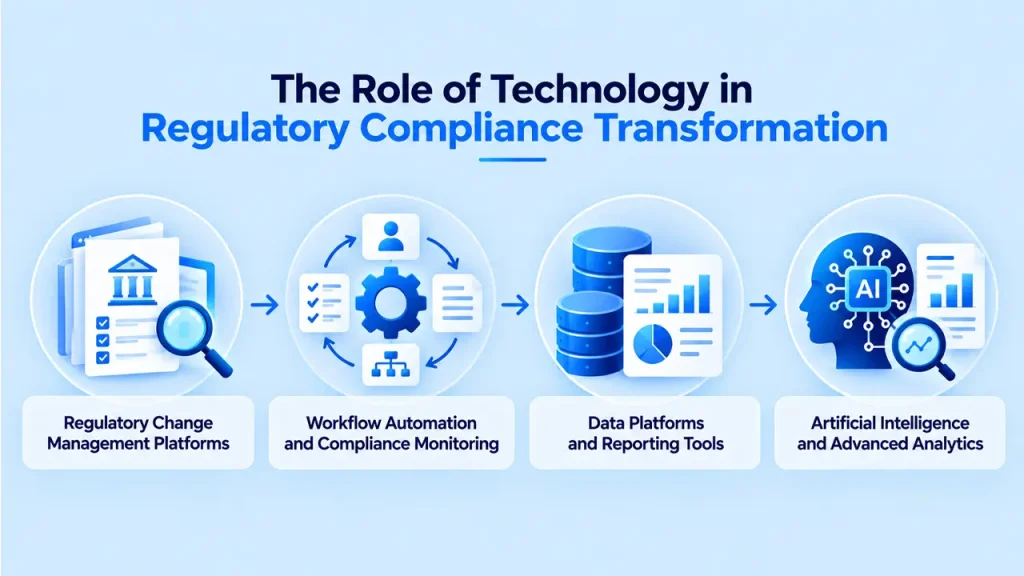
Technology can help banks make regulatory processes more consistent, traceable and scalable. However, its effectiveness depends on sound data, clearly defined processes and appropriate governance. PwC’s Global Compliance Survey 2025 reported that 82% of surveyed organisations planned to increase investment in at least one compliance technology, while 72% used technology for regulatory disclosures and reporting. These findings cover organisations across industries, including financial services, and should not be interpreted as bank-only statistics.
Regulatory Change Management Platforms
These platforms help banks maintain regulatory inventories, assign obligation owners, track implementation progress and retain supporting evidence. They provide a central view of regulatory developments and the changes required across business functions. Their effectiveness depends on accurate regulatory interpretation and reliable information; a platform can track an obligation but cannot independently guarantee that it has been implemented correctly.
Workflow Automation and Compliance Monitoring
Workflow automation supports task assignment, approvals, escalation, exception management and evidence collection. It can reduce manual coordination and help teams apply consistent procedures across recurring compliance activities. Automated monitoring can also identify unusual transactions, missing information or control exceptions, provided that thresholds, oversight and escalation procedures are appropriately designed.
Data Platforms and Reporting Tools
Data platforms can consolidate information from different systems, apply consistent transformation rules and improve reporting traceability. Reporting tools can automate calculations, validation and report generation while preserving relevant evidence. However, incorrect source data or poorly maintained calculation logic can still produce inaccurate results, making data governance and controlled system changes essential.
Artificial Intelligence and Advanced Analytics
Artificial intelligence may support regulatory document classification, obligation mapping, policy comparison and anomaly detection. These applications can help teams analyse large volumes of information and prioritise reviews, but AI-generated interpretations should not be treated as definitive legal or regulatory conclusions. Banks need human review, traceable source references and appropriate controls for accuracy, confidentiality and access.
How AI is Shaping the Future of Banking Regulatory Compliance
Artificial intelligence (AI) is creating new opportunities for banks to manage regulatory compliance more efficiently. AI-powered tools can help monitor regulatory updates, identify changes in compliance requirements, analyse large volumes of regulatory information and flag potential risks. They can also support regulatory reporting by identifying data inconsistencies and automating routine checks. As regulatory obligations become more complex, these capabilities can help banks reduce manual work and respond to changes more consistently.
Industry research highlights both the growing interest in AI and the challenges of adoption. KPMG’s 2025 Banking Survey found that 71% of surveyed US banking executives reported active AI initiatives, pilots or production use in regulatory compliance and risk management. Meanwhile, Wolters Kluwer’s 2026 Banking Compliance AI Trend Report found that 31.8% of surveyed financial institutions had deployed AI or machine learning into production, while only 12.2% described their AI strategy as well-defined and adequately resourced. These findings suggest that adopting AI is only one part of the transformation; banks also need clear governance, reliable data and appropriate implementation plans.
However, AI should complement rather than replace regulatory expertise and human oversight. Banks must address data privacy, model risk, explainability and the potential for inaccurate AI-generated outputs. By combining AI capabilities with robust governance and expert review, banks can build a more proactive and adaptable approach to regulatory compliance.
How Banks Can Measure Regulatory Transformation Success
Regulatory transformation should be assessed by whether obligations have been implemented effectively and whether the resulting processes remain reliable. Project completion and deadline adherence are important, but they do not independently demonstrate that controls work as intended.
Banks can use a balanced scorecard that includes:
| Performance indicator | What it measures |
| Regulatory obligation coverage | Applicable obligations mapped to owners, controls and implementation activities |
| Milestone and deadline adherence | Delivery against approved implementation timelines |
| Data quality and reconciliation exceptions | Accuracy, completeness and consistency of reporting data |
| Reporting errors and resubmissions | Frequency of reporting defects and required corrections |
| Control effectiveness | Whether controls operate as designed and produce adequate evidence |
| Remediation ageing | How long identified issues remain unresolved, considering severity |
| Manual intervention | The extent of manual correction and repetitive work in key processes |
| Audit and assurance findings | Gaps in implementation, documentation or ongoing compliance |
Banks should establish baseline measurements, define consistent calculation methods and assign responsibility for monitoring each indicator. Targets should reflect the institution’s regulatory obligations, risk profile and operating context rather than relying on generic benchmarks. Regular review helps management identify weaknesses, prioritise remediation and improve future transformation programmes.
Conclusion
Regulatory transformation in banking requires more than interpreting regulatory requirements or installing compliance technology. Banks must coordinate regulatory change management with process redesign, data governance, reporting architecture, control implementation and operating-model adjustments. Evidence from the Basel Committee and European Banking Authority demonstrates why this work remains important, particularly in risk data aggregation and the management of supervisory reporting requirements.
A structured implementation lifecycle, clear accountability and measurable outcomes help banks manage regulatory changes more consistently. By combining authoritative regulatory interpretation, reliable data, appropriate technology and ongoing assurance, banks can develop a more adaptable and sustainable approach to regulatory change.