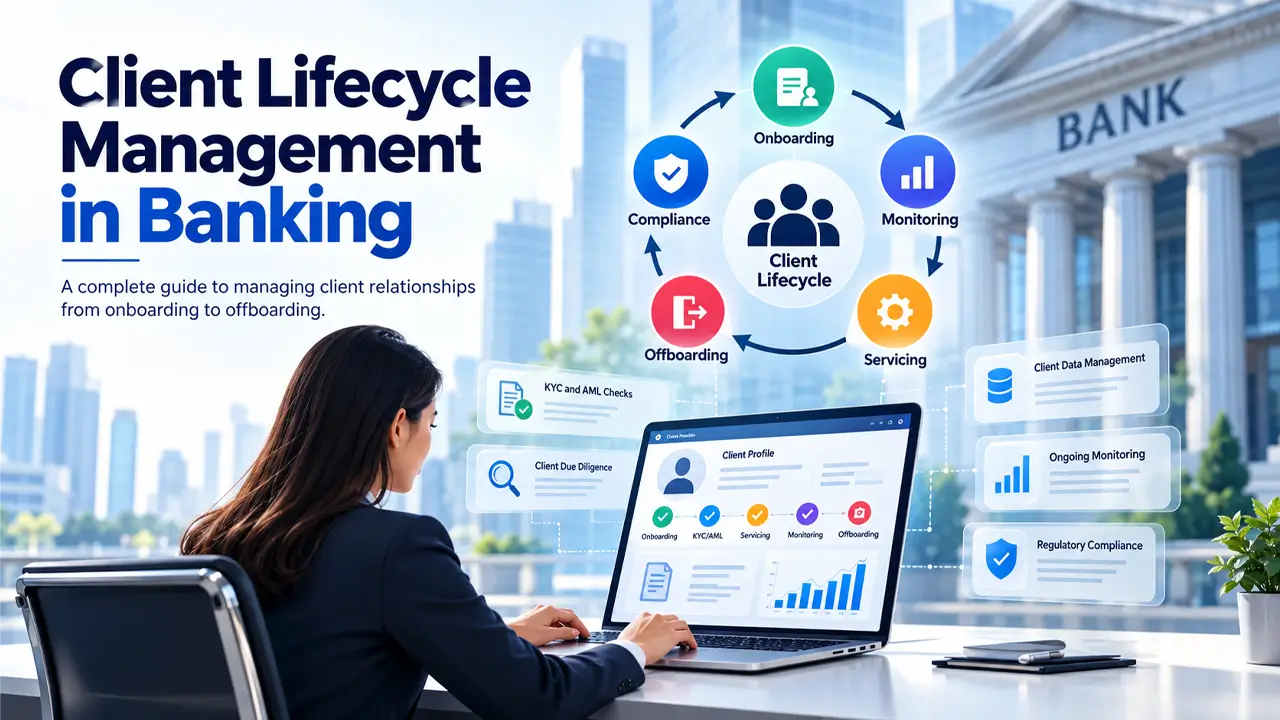
Client Lifecycle Management (CLM) in banking is the end-to-end process of managing client relationships throughout their entire lifecycle, including onboarding, Know Your Customer (KYC) verification, risk assessment, ongoing monitoring, periodic reviews, client servicing and offboarding. It connects compliance, client data and operational workflows to help banks maintain accurate records, manage risks and deliver consistent client experiences. Integrated CLM platforms enable financial institutions to coordinate these activities across departments and systems.
The World Bank’s Global Findex Database 2025 reports that 79% of adults worldwide had a financial account in 2024, compared with 74% in 2021, highlighting the continued expansion of access to formal financial services. Banks need a coordinated approach that connects client information, compliance checks and servicing activities throughout the relationship. Digital onboarding, automated workflows, centralised data management and event-driven reviews can help address these challenges. Effective banking client lifecycle management therefore involves more than meeting compliance requirements; it also supports operational efficiency, informed decision-making and long-term client relationships.
What is Client Lifecycle Management in Banking?
Client Lifecycle Management in Banking refers to the coordinated management of client information, relationships, compliance obligations and operational activities throughout the period a client maintains a relationship with a financial institution. It establishes a structured process for collecting client information, assessing risks, maintaining records, monitoring changes and managing relationship closure.
CLM typically encompasses several connected activities:
- Client onboarding: Collecting information, verifying identity and establishing the relationship.
- KYC and due diligence: Understanding client identity, ownership, activities and relevant risk factors.
- Client-data management: Maintaining accurate, consistent and accessible client records.
- Ongoing monitoring: Identifying relevant changes in client circumstances, risk exposure or account activity.
- Periodic reviews: Reassessing client information and risk according to applicable requirements and internal policies.
- Client servicing and suitability: Supporting appropriate products, services and ongoing relationship management.
- Offboarding: Managing relationship closure, outstanding obligations and required record retention.
CLM is closely related to Customer Relationship Management (CRM) and KYC, but these terms describe different functions. CRM primarily supports relationship management, sales and client interactions. KYC focuses on client identification, verification and due diligence. CLM coordinates a broader range of lifecycle activities, potentially integrating CRM, KYC, compliance and core banking systems within a connected operating model.
Why is Client Lifecycle Management Important for Banks?
Client lifecycle management helps banks coordinate operational processes, manage compliance responsibilities and maintain a consistent understanding of their clients. Its value becomes particularly clear when institutions serve large client populations across multiple business units, products, jurisdictions and regulatory environments.
The financial impact of compliance operations highlights why banks need better-coordinated client lifecycle processes. A March 2024 study by LexisNexis Risk Solutions, conducted by Forrester Consulting, estimated that annual financial crime compliance costs across the APAC markets covered by its research had reached US$45 billion. The study also found that 98% of surveyed financial institutions experienced higher compliance costs in 2023. These findings underline the importance of managing compliance workflows, client information and operational resources efficiently, without weakening required controls.
Improving Operational Efficiency and Reducing Manual Work
Disconnected systems often require employees to enter the same information repeatedly, request documents that have already been supplied and transfer cases manually between departments. These activities increase administrative workloads and can slow onboarding, account maintenance and periodic reviews.
An integrated CLM platform can automate document collection, workflow routing, approval notifications and review scheduling. Reusing verified information where appropriate also reduces unnecessary duplication. Employees can spend more time resolving complex cases and less time coordinating routine administrative tasks.
Strengthening Compliance and Risk Visibility
Banks must understand their clients, assess relevant risks and maintain appropriate controls throughout the relationship. However, fragmented client records can make it difficult to identify missing information, overdue reviews or changes that require further investigation.
CLM can provide a consolidated view of client information, due diligence status, risk assessments, outstanding actions and review history. Workflow alerts and audit trails help teams identify exceptions and demonstrate how relevant activities were handled. These capabilities support compliance oversight, although the effectiveness of the controls depends on sound governance, reliable data and appropriate human review.
Improving Client Experience and Time to Revenue
A lengthy or repetitive onboarding process can frustrate prospective clients and delay access to banking services. Repeated document requests and unclear application status can also undermine confidence in the institution.
Digital onboarding and coordinated workflows help clients submit information through more convenient channels while enabling employees to monitor outstanding requirements. Faster processing can support earlier account activation and revenue generation, subject to verification, approval and regulatory requirements. Consistent servicing after onboarding also helps maintain stronger client relationships.
What Are the Key Stages of Client Lifecycle Management in Banking?
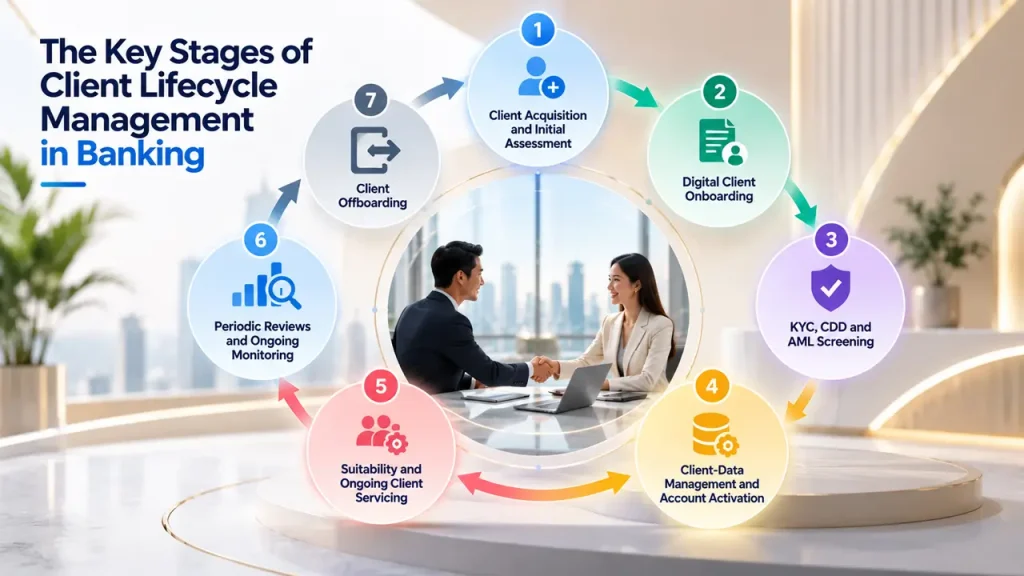
An effective banking client lifecycle management process connects each stage so that information collected during onboarding remains useful throughout the relationship. The exact workflow varies according to the client segment, banking product, risk profile and applicable regulatory obligations.
1. Client Acquisition and Initial Assessment
The lifecycle begins when a prospective client expresses interest in a banking product or service. Banks collect preliminary information about the client’s requirements, eligibility, intended products, business activities and jurisdiction to identify potential risks or restrictions. For corporate clients, this may also include details about business structure and ownership, helping determine the appropriate onboarding workflow and any additional due diligence requirements.
2. Digital Client Onboarding in Banking
Digital client onboarding in banking enables clients to submit information and supporting documents through online applications or mobile banking channels. Typical activities include identity verification, document collection, data validation and application processing, while corporate clients may need to provide information about legal entities, directors, authorised representatives and beneficial owners. Integrated workflows can identify missing documents, track application progress and route exceptions to the appropriate teams, reducing manual coordination without compromising verification standards or risk controls.
3. KYC, Customer Due Diligence and AML Screening
Know Your Customer (KYC), Customer Due Diligence (CDD) and Anti-Money Laundering (AML) procedures help banks verify client identities and assess financial crime risks. Depending on the client and jurisdiction, checks may include beneficial ownership verification, sanctions screening, politically exposed person screening, risk assessment and enhanced due diligence, with source-of-funds or source-of-wealth information required where applicable. A CLM platform coordinates these activities, tracks unresolved alerts and records approvals, while banks ensure that screening results are properly assessed and due diligence follows applicable regulations, client risk and internal policies.
4. Client-Data Management and Account Activation
After completing the required checks and approvals, banks must maintain accurate client records and transfer relevant information to systems such as core banking platforms, CRM applications and document repositories. Centralised client-data management helps maintain consistent identity, ownership, contact and account information while identifying missing fields and duplicate records. Connected CLM workflows track approval status and outstanding requirements, supporting controlled account activation and consistent information across banking systems.
5. Suitability and Ongoing Client Servicing
Client lifecycle management continues after account opening through ongoing servicing and the delivery of appropriate financial products. In wealth management and investment services, suitability assessments may consider investment objectives, financial circumstances, knowledge, experience and risk tolerance, depending on applicable requirements. CLM workflows help relationship managers access current client information, coordinate documentation and identify changes requiring reassessment, supporting consistent servicing while ensuring that recommendations follow relevant regulatory and institutional requirements.
6. Periodic Reviews and Ongoing Monitoring
Client circumstances and risk profiles can change after onboarding because of business restructuring, ownership changes, entry into new jurisdictions or unusual activity. Periodic reviews reassess client information according to applicable requirements and risk classifications, while ongoing monitoring identifies relevant developments between scheduled reviews. Client lifecycle management automation supports review scheduling, evidence collection, case assignment and escalation, while perpetual KYC (pKYC) can enable more continuous, event-driven updates; appropriate investigation, reliable data and human oversight remain essential.
7. Client Offboarding
Client offboarding involves the controlled closure of a banking relationship when a client requests termination or the bank determines that closure is appropriate. Activities may include settling outstanding obligations, closing accounts, terminating services, updating connected systems and retaining records for the required period, subject to applicable legal and regulatory requirements. A structured CLM workflow coordinates approvals and documents closure activities, reducing the risk of inconsistent records or services remaining active unintentionally.
How Does a CLM Platform for Banks Work?
A CLM platform for banks connects the systems, data and workflows involved in managing client relationships. It coordinates onboarding, compliance, servicing, periodic reviews and offboarding, helping banks reduce fragmented processes and improve visibility across the client lifecycle.
Centralised Client Data and Document Management
A CLM platform provides authorised employees with a consolidated view of client profiles, supporting documents, verification results, risk assessments and lifecycle status. Data governance controls establish which information is authoritative, who can access it and how changes are recorded. This helps reduce duplicate data entry, improve record consistency and maintain traceable histories of documents, decisions and activities.
Workflow Automation and Case Orchestration
Workflow automation assigns tasks, tracks dependencies, routes approvals and escalates unresolved cases. Applications with complete documentation and satisfactory screening results can follow standard workflows, while complex ownership structures or unresolved checks can trigger additional reviews. Configurable rules help banks manage different client segments and risk categories, while status tracking highlights bottlenecks, overdue tasks and recurring exceptions.
Integration with KYC, AML, CRM and Core Banking Systems
A CLM platform connects with identity verification providers, screening tools, CRM applications, document repositories and core banking systems through APIs and other approved data interfaces. These integrations reduce manual information transfers and help maintain consistent client records across departments. Effective implementation requires reliable data mapping, appropriate access permissions, system security and error-handling procedures.
AI-Assisted Reviews, Monitoring and Reporting
AI and intelligent automation can support document classification, information extraction, data comparison, case prioritisation and the identification of potential inconsistencies. Dashboards can also highlight onboarding progress, review backlogs, unresolved alerts and workflow performance, helping managers identify operational issues and allocate resources. Banks must validate AI-generated outputs and maintain appropriate controls for accuracy, privacy, explainability, bias and human oversight, particularly when compliance decisions or client access are affected.
How Is AI Transforming Client Lifecycle Management in Banking?
Industry research indicates that AI is becoming relevant to banking onboarding processes. Capgemini Research Institute’s World Cloud Report in Financial Services 2026 found that 59% of surveyed banking executives identified customer onboarding as a process for deploying AI agents at scale. However, only 10% of surveyed financial-services firms had implemented AI agents at scale, highlighting the gap between planned applications and mature deployment. These findings support the case for exploring AI within CLM while setting realistic expectations for implementation.
AI can support banking client lifecycle management in several ways:
- AI-powered client onboarding: Extracts information from identity documents and company records, identifies missing details and flags inconsistencies for review, helping reduce repetitive administrative work.
- AI for KYC, AML and risk assessment: Helps compliance teams prioritise screening alerts, identify unusual patterns and analyse relationships between clients and beneficial owners, supporting more focused investigations.
- AI-driven client servicing: Assists relationship managers with client-history summaries, information retrieval and review preparation, supporting more consistent communication and relationship management.
- AI governance and human oversight: Requires appropriate controls for data privacy, accuracy, security, bias and accountability, with human review for sensitive compliance assessments and decisions affecting clients.
Client Lifecycle Management in Wealth Management
Client lifecycle management in wealth management requires particular attention to complex client relationships, financial objectives, ownership structures and suitability obligations. A relationship may involve multiple accounts, family members, trusts, companies, investment products and jurisdictions, making accurate and connected client information especially important.
The lifecycle may include enhanced understanding of the client’s financial circumstances, beneficial ownership, source of wealth where relevant, investment objectives and risk tolerance. Relationship managers must maintain appropriate information and coordinate reviews when a client’s circumstances, objectives or relevant regulatory requirements change.
An integrated CLM platform can connect client profiles, due diligence records, suitability information and servicing workflows. This helps authorised teams maintain a more consistent view of the relationship and reduces the need to collect the same information repeatedly. It can also support more coordinated communication across relationship management, operations and compliance teams.
The objective is to combine effective risk management with personalised service. Technology can improve information availability and process consistency, but it must support rather than replace professional judgement and applicable suitability controls.
Common Challenges in Client Lifecycle Management
Banks may struggle to achieve an effective CLM operating model when lifecycle activities are spread across disconnected applications, inconsistent procedures and departmental workflows. These issues can increase costs, create delays and make it harder to maintain accurate client information.
Common challenges include:
- Fragmented systems: Client information is distributed across applications that do not exchange data effectively.
- Manual processes: Employees repeatedly collect documents, enter information and coordinate approvals.
- Inconsistent data quality: Duplicate records, missing fields and outdated information undermine reliable assessments.
- Review backlogs: Poor workflow visibility and limited resources delay periodic reviews and exception resolution.
- Complex regulatory requirements: Different client types and jurisdictions require appropriately configured controls.
- Integration and governance risks: New technology can introduce security, data ownership and operational resilience challenges if implementation is poorly managed.
Addressing these challenges requires more than introducing automation. Banks should review existing processes, establish clear data ownership, define consistent procedures and prioritise improvements according to business impact and risk.
How to Transform Banking Client Lifecycle Management
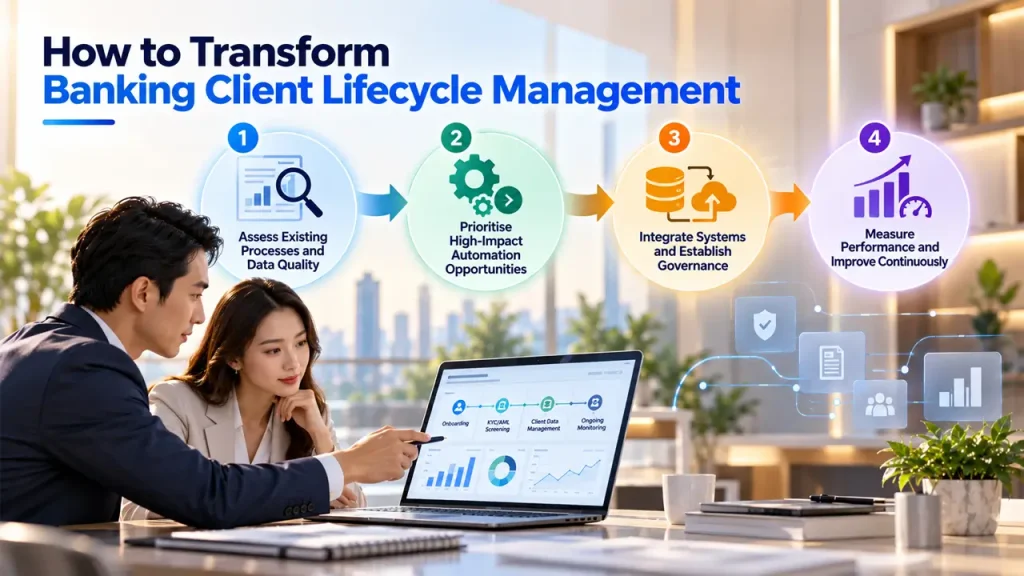
Transforming banking client lifecycle management requires a structured approach that aligns technology investment with operational needs, compliance obligations and measurable business outcomes.
Assess Existing Processes and Data Quality
Begin by mapping the current client journey and identifying duplicated activities, disconnected systems, manual handoffs and recurring delays. Establish baseline measurements for onboarding time, review backlogs, manual processing effort and data quality. This provides a foundation for prioritising improvements.
Prioritise High-Impact Automation Opportunities
Identify repeatable, rules-based tasks that can be automated safely, such as document routing, completeness checks, reminders and review scheduling. Pilot these improvements in a defined client segment or workflow before expanding them across the organisation. Complex cases and higher-risk decisions should retain appropriate human oversight.
Integrate Systems and Establish Governance
Connect the CLM platform with relevant banking systems while defining data ownership, access permissions, audit requirements and exception-handling procedures. Security, privacy, resilience and regulatory requirements should be incorporated into the design and implementation process rather than addressed only after deployment.
Measure Performance and Improve Continuously
Monitor key performance indicators such as average onboarding time, manual touchpoints per application, review completion rates, outstanding case volumes, data-quality exceptions and client satisfaction. Compliance indicators should also reflect the effectiveness of controls, not merely the volume of cases processed.
Banks can use these measurements to identify bottlenecks, refine workflows and evaluate whether the transformation is delivering its intended benefits. Improvements should be reviewed regularly as client needs, business priorities and regulatory requirements evolve.
Conclusion
Client Lifecycle Management in Banking provides a coordinated approach to managing client relationships, compliance activities and operational processes throughout the client journey. By connecting onboarding, KYC, client-data management, suitability, ongoing monitoring, periodic reviews and offboarding, banks can improve process visibility and reduce unnecessary manual work while maintaining appropriate risk controls.
Integrated CLM platforms, workflow automation and carefully governed AI capabilities can support this transformation by connecting fragmented systems and making relevant client information more accessible to authorised teams. Achieving lasting improvements requires clear processes, reliable data, effective integration and measurable performance objectives.
Banks that treat CLM as an ongoing operational transformation initiative can build a more consistent foundation for client servicing, compliance oversight and scalable digital operations. The most effective approach combines technology with sound governance and continuous process improvement, ensuring that efficiency gains support both institutional requirements and client needs.
Frequently Asked Questions
Client lifecycle management in banking is the process of managing a client relationship throughout its duration, covering onboarding, KYC, due diligence, client-data management, servicing, ongoing monitoring, periodic reviews and offboarding.
KYC focuses on identifying and verifying clients and understanding relevant risk factors. CLM covers the broader client relationship, coordinating KYC with onboarding, data management, servicing, ongoing reviews and relationship closure.
Automation can reduce repetitive data entry, route cases between teams, track missing documents, schedule reviews and improve workflow visibility. Its effectiveness depends on reliable data, appropriate controls, system integration and human oversight where required.
Core capabilities may include centralised client records, digital onboarding, document management, KYC and AML integrations, risk assessment, workflow orchestration, periodic review scheduling, audit trails and reporting. The appropriate feature set depends on the bank’s business model and regulatory environment.
Wealth management often involves complex ownership structures, multiple accounts, cross-border relationships and suitability considerations. Integrated CLM helps teams maintain current client information and coordinate compliance, relationship management and servicing activities.